Begin of page section:
Page sections:

  • Go to contents (Accesskey 1)
  • Go to position marker (Accesskey 2)
  • Go to main navigation (Accesskey 3)
  • Go to sub navigation (Accesskey 4)
  • Go to additional information (Accesskey 5)
  • Go to page settings (user/language) (Accesskey 8)
  • Go to search (Accesskey 9)

End of this page section. Go to overview of page sections

Begin of page section:
Page settings:

English en
Deutsch de
Search
Login

End of this page section. Go to overview of page sections

Begin of page section:
Search:

Search for details about Uni Graz
Close

End of this page section. Go to overview of page sections


Search

Begin of page section:
Main navigation:

Page navigation:

  • University

    University
    • About the University
    • Organisation
    • Faculties
    • Library
    • Working at University of Graz
    • Campus
    Developing solutions for the world of tomorrow - that is our mission. Our students and our researchers take on the great challenges of society and carry the knowledge out.
  • Research Profile

    Research Profile
    • Our Expertise
    • Research Questions
    • Research Portal
    • Promoting Research
    • Research Transfer
    • Ethics in Research
    • Commission for Scientific Integrity
    Scientific excellence and the courage to break new ground. Research at the University of Graz creates the foundations for making the future worth living.
  • Studies

    Studies
    • Prospective Students
    • Students
    • Registration for Study Programme (Winter semester 2026/27)
    • Welcome Weeks for First Year Students
  • Community

    Community
    • International
    • Location
    • Research and Business
    • Alumni
    The University of Graz is a hub for international research and brings together scientists and business experts. Moreover, it fosters the exchange and cooperation in study and teaching.
Topics
  • Sustainable University
  • Researchers answer
  • Work for us
Close menu

End of this page section. Go to overview of page sections

Begin of page section:
You are here:

University of Graz News In the footsteps of Jesus: Pope Francis openly approached everyone

End of this page section. Go to overview of page sections

Tuesday, 22 April 2025

In the footsteps of Jesus: Pope Francis openly approached everyone

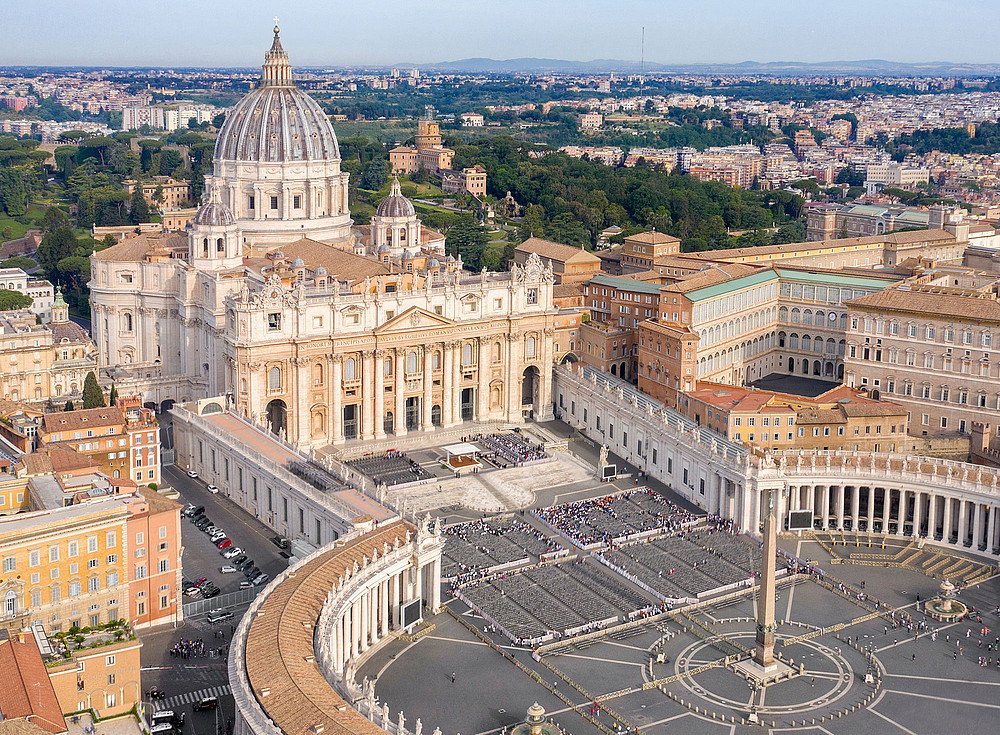
A bird's eye view of St Peter's Basilica and Square ©Stefano Tammaro - stock.adobe.com
©Stefano Tammaro - stock.adobe.com

St Peter's Basilica in Rome is the largest Christian church in the world and one of the symbols of the Vatican. Photo: Stefano Tammaro - stock.adobe.com

Pope Francis I has taken significant steps to open up the Catholic Church. On Easter Monday, he passed away at the age of 88. His commitment to the fight against poverty and the preservation of nature has left a lasting impression on society. Researchers at the Faculty of Catholic Theology at the University of Graz take a look at the legacy of Pope Francis I.

Pope Francis died on April, 21st, 2025 in Rome at the age of 88. Born and raised in Argentina, he has been the first non-European head of the Roman Catholic Church in centuries, a position he has held since 2013. Jorge Mario Bergoglio, as the descendant of Italian immigrants was originally named, was well liked by many people. He was known for his solidarity with the poor and the excluded, his – albeit very cautious – steps towards greater openness, for example with regard to the role of women in the church or same-sex couples, for interreligious dialogue and his concern for our planet in the face of climate change.

Just recently, Pope Francis condemned Trump's mass deportations of migrants in a letter to US bishops. He was a Christian who lived the message of Jesus, love for one's neighbour, showed it publicly and also demanded it from others. "His first trip in office was to the island of Lampedusa off Sicily in 2013 to draw attention to the fate of boat refugees," recalls Pablo Argárate, church historian at the Faculty of Catholic Theology at the University of Graz. The Argentine is not only a fellow countryman of the Pope, but has also studied his life in great detail. "In the 1970s, during the military dictatorship, Bergoglio was the provincial in charge of the Argentine province of the Jesuit order, which he ran in a very authoritarian way," says Argárate.

For the poor

After a study visit to Germany and his return to Argentina in the early 1990s, he changed a lot, says the theologian: "From then on, he turned to people on the margins of society with great earnest and gained great popularity." As Auxiliary Bishop and later Archbishop of Buenos Aires, and from 2001 as Cardinal, he always focused on the poor. "In 2013, shortly before his election as successor to Pope Benedict XVI, he gave a short speech in which he emphasised that the church must go out to the people instead of waiting for them to come," says Argárate. He inspired people with his friendly, natural manner and his simple language. "That made him a media star," says the church historian.

In line with the Second Vatican Council, Pope Francis wanted his church to be a pastoral church, explains theologian Martina Bär from the Department for Systematic Theology and Liturgical Studies. “By that, he meant a church that responds to the option for people, especially the marginalised in our societies,” says Bär. “During my research trips, I was repeatedly confronted with the accusation that the Catholic Church talks a good game when it comes to helping the poor, but does little of substance. Pope Francis was a pope who wanted to change that.”

For Pope Francis, reaching out to people, whether in or outside the Church, also meant seeking dialogue with other religions. In 2019, he became the first Pope to travel to the Arab world. In Abu Dhabi, he signed the "Document on Human Fraternity for a Peaceful Coexistence in the World" with Sheikh Ahmed el-Tayeb, a leading representative of Sunni Islam.

A church for everyone

Along with his concern for the poor, Pope Francis' criticism of unregulated capitalism and economic liberalism "led to him being accused of being a communist in Eastern Europe and the United States, among other places; in addition to criticism of his reforms, which were too far-reaching from the point of view of conservative circles," says Argárate. Although the Pope remained loyal to the Church's previous position on celibacy and the priesthood of women, at the same time he sent a clear signal of openness to modern social developments, for example by allowing same-sex couples to be blessed and appointing women to important positions. "In January of this year, he appointed Sister Simona Brambilla as Prefect of the Dicastery for Institutes of Consecrated Life and Societies of Apostolic Life. This is the first time that a woman has headed an authority in the Vatican. On 1 March 2025, Sister Raffaella Petrini will become the first woman to head the entire Vatican administration," adds Argárate.

Some critics say these steps don't go far enough, explains theologian Bär. “At the World Synod, many women's voices were calling for more participation. Above all, the continued lack of admission to the office of deacon is an open flank in the women's issue.” Theologian Argárate sees the reluctance on this point as rooted in concerns about the unity of the church: "It has always been very important to Francis that everyone can find themselves in it, that there is no division." The Pope strengthened the Church as an international community by appointing a particularly large number of cardinals from emerging countries and the Global South, thus giving them more weight, a greater say and more appreciation.

The Earth as a gift from God

In his first social encyclical, Laudato si, in 2015, Pope Francis placed a strong emphasis on ecology, on our planet, which needs to be protected. In doing so, he reached a large audience, far beyond the church community. "The document is considered an important contribution to the global sustainability discourse," says Thomas Gremsl from the Institute for Ethics and Social Theory at the University of Graz. On this topic, too, Pope Francis once again commented on current challenges that people and societies have to face in the here and now with a view to the future.

created by Gudrun Pichler

Related news

Courtly Love and Aubergines: What Medieval Literature Has in Common with Emojis

Plants and fruits were already used as symbols of love in the Middle Ages. German studies scholar Isabella Managò, together with her colleagues Brigitte Spreitzer-Fleck and Julia Zimmermann, explains how this came about and why this figurative language remains familiar to us to this day.

New technology from the University of Graz reveals the hidden properties of tumour cells

It sounds like science fiction, but it could advance cancer research in the future: a team at the University of Graz, led by physicist Jan Enenkel, is developing a new laboratory device using laser technology that can be used to examine individual tumour cells. The idea is reminiscent of the medical tricorder from the Star Trek film series – albeit as a high-precision measurement platform. A spin-off fellowship from the Austrian Research Promotion Agency (FFG) is supporting the development of the technology at the University of Graz with around 500,000 euros.

Four introduced species of leafhoppers newly discovered in the Botanical Garden Graz

They have travelled to Europe as stowaways via international trade and are now rapidly taking over large parts of the continent: more and more insects from other parts of the world are becoming established here. Biologist Gernot Kunz recently discovered four species for the first time at the University of Graz Botanical Garden: the American grapevine leafhopper (Scaphoideus titanus), the wounded leafhopper from North America (Erasmoneura vulnerata) and the Japanese grape leafhopper (Arboridia kakogawana) – all three specialising in vines – as well as the Indian leafhopper Pediopsoides sharmai, which is associated with walnut trees.

Researchers at the University of Graz impress with their AI expertise

A total of 170 entries were submitted to the Austrian Academy of Sciences’ essay competition on the topic of artificial intelligence and science. Both first and second place went to researchers from the University of Graz.

Begin of page section:
Additional information:

University of Graz
Universitaetsplatz 3
8010 Graz
Austria
  • Contact
  • Web Editors
  • Moodle
  • UNIGRAZonline
  • Imprint
  • Data Protection Declaration
  • Accessibility Declaration
Weatherstation
Uni Graz

End of this page section. Go to overview of page sections

End of this page section. Go to overview of page sections

Begin of page section:

End of this page section. Go to overview of page sections