Begin of page section:
Page sections:

  • Go to contents (Accesskey 1)
  • Go to position marker (Accesskey 2)
  • Go to main navigation (Accesskey 3)
  • Go to sub navigation (Accesskey 4)
  • Go to additional information (Accesskey 5)
  • Go to page settings (user/language) (Accesskey 8)
  • Go to search (Accesskey 9)

End of this page section. Go to overview of page sections

Begin of page section:
Page settings:

English en
Deutsch de
Search
Login

End of this page section. Go to overview of page sections

Begin of page section:
Search:

Search for details about Uni Graz
Close

End of this page section. Go to overview of page sections


Search

Begin of page section:
Main navigation:

Page navigation:

  • University

    University
    • About the University
    • Organisation
    • Faculties
    • Library
    • Working at University of Graz
    • Campus
    Developing solutions for the world of tomorrow - that is our mission. Our students and our researchers take on the great challenges of society and carry the knowledge out.
  • Research Profile

    Research Profile
    • Our Expertise
    • Research Questions
    • Research Portal
    • Promoting Research
    • Research Transfer
    • Ethics in Research
    • Commission for Scientific Integrity
    Scientific excellence and the courage to break new ground. Research at the University of Graz creates the foundations for making the future worth living.
  • Studies

    Studies
    • Prospective Students
    • Students
    • Post-registration Law
  • Community

    Community
    • International
    • Location
    • Research and Business
    • Alumni
    The University of Graz is a hub for international research and brings together scientists and business experts. Moreover, it fosters the exchange and cooperation in study and teaching.
Topics
  • Sustainable University
  • Researchers answer
  • Work for us
Close menu

End of this page section. Go to overview of page sections

Begin of page section:
You are here:

University of Graz News Impulse

End of this page section. Go to overview of page sections

Wednesday, 18 September 2013

Impulse

Impulse für Forschung und Lehre ermöglichen die im Zuge der Hochschulraumstrukrurmittel bewilligten Mittel
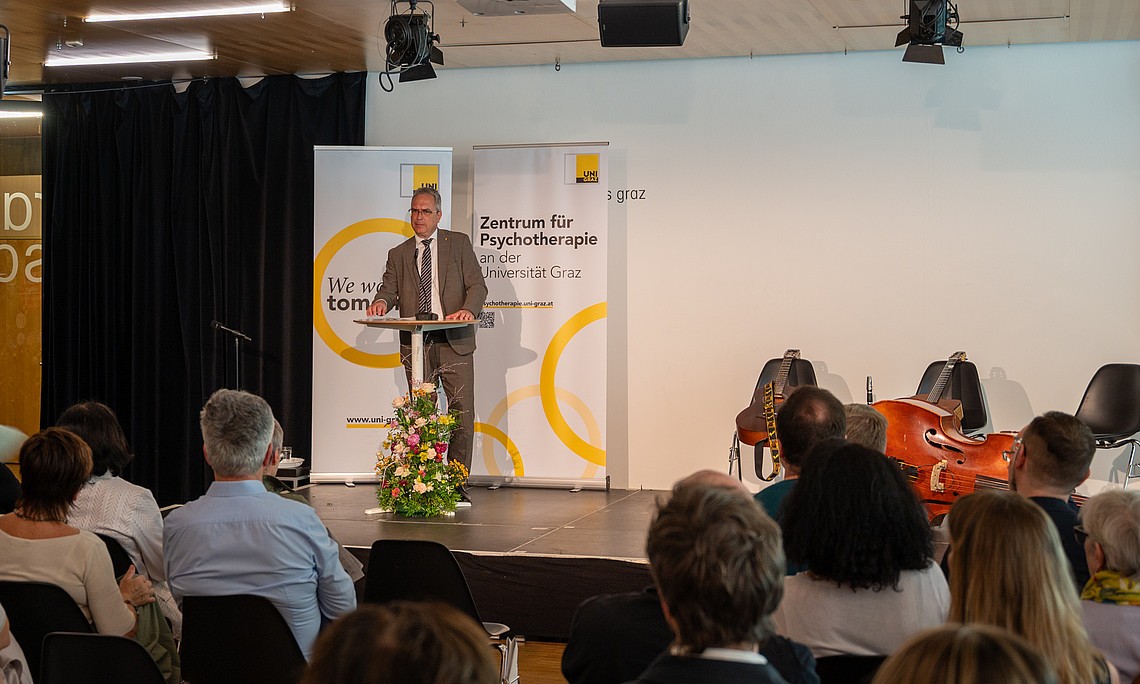
Impulse für Forschung und Lehre ermöglichen die im Zuge der Hochschulraumstrukrurmittel bewilligten Mittel

Hochschulraumstrukturmittel für Forschung und Lehre: Uni Graz erhält 5,3 Millionen Euro für Kooperationsprojekte

Fünf Projekte mit einer Fördersumme von insgesamt 5,261.000 Millionen Euro konnte die Karl-Franzens-Universität bei der Vergabe der Hochschulraumstrukturmittel des Wissenschaftsministeriums an Land ziehen.
„Die Uni Graz unterstreicht ihre bedeutende Rolle als Kooperations-Universität. Wir können mit der Anschaffung dringend benötigter Infrastruktur sowohl Impulse für die Forschung setzen als auch Leitprojekte in der Lehre verwirklichen“, bekräftigt Rektorin Christa Neuper. Das Gesamtvolumen der fünf bewilligten Vorhaben beläuft sich auf knapp 19 Millionen Euro. Die Uni Graz hatte insgesamt 22 Projekte beantragt. Zusätzlich wurden sechs Projekte genehmigt, bei denen die Uni Graz als Partnerin beteiligt ist. Für diese Projekte stellt das BMWF allen KooperationspartnerInnen eine Vergabesumme von insgesamt 6,4 Millionen Euro bereit.

Hochmoderne bildgebende Verfahren

Die bewilligten Mittel ermöglichen unter anderem die Anschaffung eines hochmodernen Magnet-Resonanz-Geräts. Im Rahmen der Kooperation BioTechMed von Karl-Franzens-Universität, Med Uni und TU Graz wird der Standort Graz zu einem Zentrum für präklinisches, sogenanntes Bioimaging für hochauflösende bildgebende Verfahren weiter ausgebaut, Forschungen rund um Tumorerkrankungen intensiviert. Die international bahnbrechende Technologie wird mit insgesamt 2,500.000 Euro gefördert.

Ein Aufnahmeverfahren für 15 Bildungsinstitutionen
Auf Initiative der Uni Graz haben sich insgesamt sechs Universitäten und neun Pädagogische Hochschulen in ganz Österreich zusammengeschlossen (900.000 Euro). Ziel des Schulterschlusses ist es, dass künftig verpflichtende Aufnahme- und Auswahlverfahren für die Lehramtsstudien gemeinsam qualitätsvoll und zugleich effizient zu realisieren. Nach Abschluss der Entwicklungsphase ist die Umsetzung ab dem Wintersemester 2014/15 vorgesehen.

Freier Zugang zum Wissenschaftserbe der Steiermark
Das Projekt „Repositorium Steirisches Wissenschaftserbe“ (1,1 Millionen Euro) umfasst in Zusammenarbeit mit der Kunstuniversität und TU Graz, der Landesregierung Steiermark und Stadt Graz und weiteren wissenschaftlichen Einrichtungen die digitale Aufbereitung, Sicherung sowie verbesserte Zugänglichkeit steirischer Wissenschaftsergebnisse. Das Vorhaben ergänzt österreichweite Aktivitäten, Publikationen mit Open-Access zur Verfügung zu stellen.

Verbesserte Beschäftigungsfähigkeit der AbsolventInnen
Die Umsetzung anwendungs- und praxisorientierter Betriebswirtschaftsmodule hat „TIME-Gate -Transferinitiative für Management und Entrepreneurship“ im Bereich der Unternehmensführung (370.000 Euro) zum Ziel. In Abstimmung mit dem Science Park Graz, der TU Graz, der Medizinischen Universität sowie weiteren externen PartnerInnen kann den Studierenden ein neuartiges Angebot bereitgestellt werden. Dadurch soll die Beschäftigungsfähigkeit der AbsolventInnen erhöht werden.

Nanostrukturen unter der Lupe
Im Bereich von NAWI Graz, die naturwissenschaftliche Kooperation von Karl-Franzens-Universität und TU Graz, kann mit dem genehmigten Finanzierung von 400.000 Euro eine Infrastruktur-Lücke in den Nanowissenschaftenschaften geschlossen werden. Ein modernes Gerät zur Nanostrukturierung mit Hilfe der Elektronenstrahl-Lithographie ermöglicht Einblicke in kleinste molekulare Strukturen.

created by Andreas Schweiger

Related news

The future of Styria as a knowledge region is at risk

It is reported that 500 million euros are to be cut from Styrian universities. University vice-chancellors fear that this will sacrifice the development and competitiveness of the region as a centre for science, culture and business in favour of short-term cost-cutting targets.

A good winter for honeybees: mortality rate in Austria below ten per cent

20 May is World Bee Day. Local beekeepers can celebrate it with confidence this year, as their colonies have come through the winter relatively well.

Whistles against division: Rivka Saltiel experienced both unrest and solidarity in the US

Rivka Saltiel, a geographer from the University of Graz, has been working as a visiting professor in Minneapolis for the past five months and has witnessed first-hand the state of emergency and the deadly raids carried out by the immigration agency ICE. She reports on the collective solidarity of the population, the resistance to the President’s attempts to divide the community, and the power of informal social networks that ensure day-to-day provision and safety. These practices of solidarity are also relevant for Europe.

Record of reported species: Styria wins the global City Nature Challenge

Observers in Styria recorded 5,158 different animals, plants and fungi as part of the international City Nature Challenge between 24 and 27 April 2026. This saw the region take first place in the "species" category. Ostrava in the Czech Republic made the most observations, with just under 140,000, whilst the San Francisco Bay Area had the highest number of participants, namely 3,019.

Begin of page section:
Additional information:

University of Graz
Universitaetsplatz 3
8010 Graz
Austria
  • Contact
  • Web Editors
  • Moodle
  • UNIGRAZonline
  • Imprint
  • Data Protection Declaration
  • Accessibility Declaration
Weatherstation
Uni Graz

End of this page section. Go to overview of page sections

End of this page section. Go to overview of page sections

Begin of page section:

End of this page section. Go to overview of page sections