Begin of page section:
Page sections:

  • Go to contents (Accesskey 1)
  • Go to position marker (Accesskey 2)
  • Go to main navigation (Accesskey 3)
  • Go to sub navigation (Accesskey 4)
  • Go to additional information (Accesskey 5)
  • Go to page settings (user/language) (Accesskey 8)
  • Go to search (Accesskey 9)

End of this page section. Go to overview of page sections

Begin of page section:
Page settings:

English en
Deutsch de
Search
Login

End of this page section. Go to overview of page sections

Begin of page section:
Search:

Search for details about Uni Graz
Close

End of this page section. Go to overview of page sections


Search

Begin of page section:
Main navigation:

Page navigation:

  • University

    University
    • About the University
    • Organisation
    • Faculties
    • Library
    • Working at University of Graz
    • Campus
    Developing solutions for the world of tomorrow - that is our mission. Our students and our researchers take on the great challenges of society and carry the knowledge out.
  • Research Profile

    Research Profile
    • Our Expertise
    • Research Questions
    • Research Portal
    • Promoting Research
    • Research Transfer
    • Ethics in Research
    Scientific excellence and the courage to break new ground. Research at the University of Graz creates the foundations for making the future worth living.
  • Studies

    Studies
    • Prospective Students
    • Students
  • Community

    Community
    • International
    • Location
    • Research and Business
    • Alumni
    The University of Graz is a hub for international research and brings together scientists and business experts. Moreover, it fosters the exchange and cooperation in study and teaching.
  • Spotlight
Topics
  • Our digital Advent calendar
  • Sustainable University
  • Researchers answer
  • Work for us
Close menu

End of this page section. Go to overview of page sections

Begin of page section:
You are here:

University of Graz News Hunga eruption changes the atmosphere: researchers show effects

End of this page section. Go to overview of page sections

Wednesday, 28 August 2024

Hunga eruption changes the atmosphere: researchers show effects

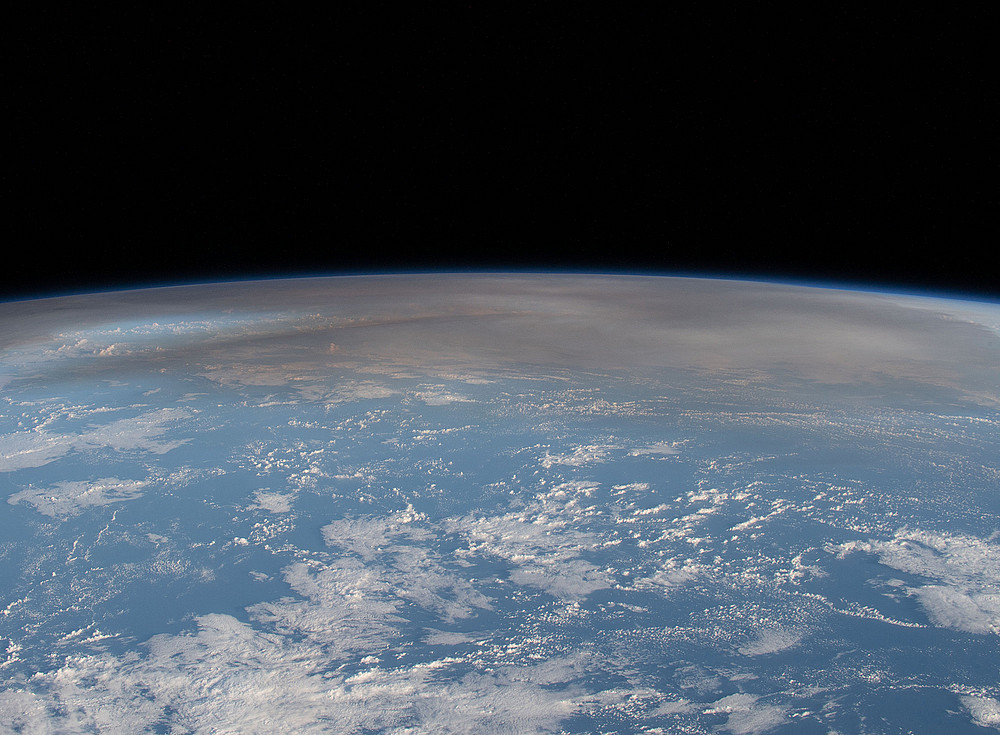
The atmospheric plume from the eruption of the underwater volcano Hunga in the Pacific nation of Tonga, pictured from the International Space Station ISS ©NASA/Kayla Barron, Public domain, Wikimedia Commons

The atmospheric plume from the eruption of the underwater volcano Hunga in the Pacific nation of Tonga, pictured from the International Space Station ISS on 16 January 2022. The effects of the eruption in the atmosphere will last for years to come. Photo: NASA/Kayla Barron, Public domain, Wikimedia Commons

Less than a week ago, lava began to bubble up from the earth again in Iceland. In Sicily, Mount Etna does not come to rest. The eruption of a volcano can have massive consequences for a region. But its breath can also reach far beyond. During the eruption of Hunga in January 2022, the largest volcanic event of the 21st century to date, an unprecedented amount of water vapour was released into the upper atmosphere. Researchers from the Wegener Center at the University of Graz, in collaboration with colleagues from the USA, have investigated the changes in these high layers of air. They found an exceptional cooling of the stratosphere. This has far-reaching effects on the atmosphere and the climate. The study has recently been published in Communications Earth & Environment.

The eruption of Hunga in the Pacific, north of New Zealand, was the strongest in the world after that of Mount Pinatubo on the Philippines in 1991. Unlike Pinatubo, Hunga is an underwater volcano. "The enormous amount of water vapour released during its eruption led to significant changes in the atmosphere," reports Matthias Stocker, lead author of the publication analysing these effects. "In our study, we used satellite observations and detected an exceptionally strong cooling of the stratosphere by up to four degrees Celsius, which lasted until mid-2023," says the researcher from the Wegener Center at the University of Graz. "This cooling continues into even higher layers of the atmosphere and is expected to have an effect for several years to come," says Stocker.
"There are changes in the composition and circulation of the atmosphere, such as the destruction of ozone and a deepening of the Antarctic ozone hole," explains Andrea Steiner, co-author and head of the Graz research team. "The effects of this volcanic eruption on the climate near the ground are comparatively small, so people are unlikely to notice them in their daily lives," Steiner adds, although research is still ongoing.

The study authors also consider the Hunga eruption to be a natural experiment that provides valuable insights into how eruptions affect atmospheric conditions. "In addition, the results of our research help to optimise climate models and improve predictions of global changes in atmospheric and climatic processes," says Stocker, underlining the importance of the publication.

Publication
Observed impacts of the Hunga eruption on stratospheric temperature
Stocker, M., Steiner, A.K., Ladstädter, F., Foelsche, U. and Randel, W.J. (2024)
Communications Earth & Environment, doi:10.1038/s43247-024-01620-3

created by Gudrun Pichler

Related news

Chemical Christmas show at the University of Graz: An explosive evening at the Schauspielh

At the beginning of December, the University of Graz transformed the theater into a laboratory: as part of “Chemical Life,” teacher training students staged a chemical Christmas show for Styrian school classes—complete with ethanol rockets, nitrogen snow, and glowing effects. An evening designed to inspire interest in studying chemistry.

Train by train: Koralm railway accelerates exchange between the Universities

Lectures at the University of Klagenfurt in the morning, seminars at the University of Graz in the afternoon: Austria's longest tunnel and a journey time of around 45 minutes make it easy. The Koralm railway increases the speed of networking between the two university locations. The collaboration builds on existing cooperation - for example in the areas of teacher training, Slavic studies and as employers, the universities are well coordinated.

On the trail of the Big Bang: University of Graz receives 1.5 million euros for doctoral programmes

The Austrian Science Fund FWF has selected the Doctoral Programme in Theoretical Particle Physics at the University of Graz for funding from the Doc.funds. Six young scientists will be funded for 3.5 years. They will gain fundamentally new insights into the origins of the world.

From trans women and knee prostheses: sports science prizes awarded

Walking better with a prosthesis, successfully getting rid of excess weight, training more effectively, more fairness for trans people in sport: these were the topics addressed by the students at the University of Graz who were awarded the sports science prizes for their Master's theses on 3 December 2025.

Begin of page section:
Additional information:

University of Graz
Universitaetsplatz 3
8010 Graz
Austria
  • Contact
  • Web Editors
  • Moodle
  • UNIGRAZonline
  • Imprint
  • Data Protection Declaration
  • Accessibility Declaration
Weatherstation
Uni Graz

End of this page section. Go to overview of page sections

End of this page section. Go to overview of page sections

Begin of page section:

End of this page section. Go to overview of page sections