



Begin of page section:
Page sections:

  • Go to contents (Accesskey 1)
  • Go to position marker (Accesskey 2)
  • Go to main navigation (Accesskey 3)
  • Go to sub navigation (Accesskey 4)
  • Go to additional information (Accesskey 5)
  • Go to page settings (user/language) (Accesskey 8)
  • Go to search (Accesskey 9)

End of this page section. Go to overview of page sections

Begin of page section:
Page settings:

English en
Deutsch de
Search
Login

End of this page section. Go to overview of page sections

Begin of page section:
Search:

Search for details about Uni Graz
Close

End of this page section. Go to overview of page sections


Search

Begin of page section:
Main navigation:

Page navigation:

  • University

    University
    • About the University
    • Organisation
    • Faculties
    • Library
    • Working at University of Graz
    • Campus
    Developing solutions for the world of tomorrow - that is our mission. Our students and our researchers take on the great challenges of society and carry the knowledge out.
  • Research Profile

    Research Profile
    • Our Expertise
    • Research Questions
    • Research Portal
    • Promoting Research
    • Research Transfer
    • Ethics in Research
    • Commission for Scientific Integrity
    Scientific excellence and the courage to break new ground. Research at the University of Graz creates the foundations for making the future worth living.
  • Studies

    Studies
    • Prospective Students
    • Students
    • Registration for Study Programme (Winter semester 2026/27)
    • Study Days 22-26 June 2026
  • Community

    Community
    • International
    • Location
    • Research and Business
    • Alumni
    The University of Graz is a hub for international research and brings together scientists and business experts. Moreover, it fosters the exchange and cooperation in study and teaching.
Topics
  • Sustainable University
  • Researchers answer
  • Work for us
Close menu

End of this page section. Go to overview of page sections

Begin of page section:
You are here:

University of Graz News Five by five

End of this page section. Go to overview of page sections

Wednesday, 30 November 2016

Five by five

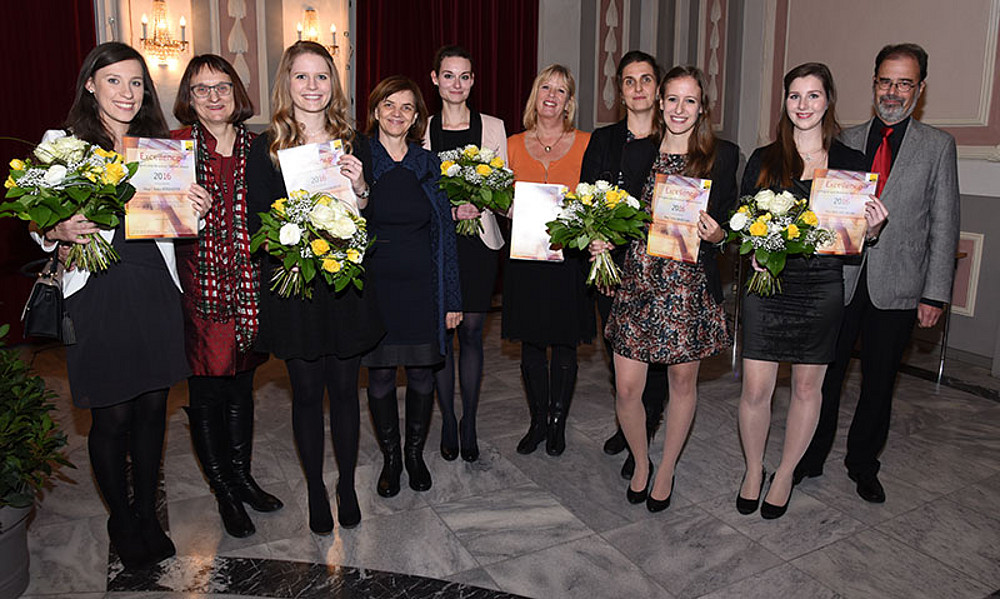
Katja Berghofer, Roberta Maierhofer, Carolina Hohenwarter, Hermine Penz, Lisa Kornder, Catharina Mennen, Silvia Schultermandl, Irina Missethan, Vera Müllner und Werner Wolf (v.l.). Foto: Uni Graz/Kastrun.

Katja Berghofer, Roberta Maierhofer, Carolina Hohenwarter, Hermine Penz, Lisa Kornder, Catharina Mennen, Silvia Schultermandl, Irina Missethan, Vera Müllner und Werner Wolf (v.l.). Foto: Uni Graz/Kastrun.

Die fünf besten AbsolventInnen des Jahres erhielten den Excellence in English and American Studies Award 2016

Es ist ein traditionelles Fest am Ende des Uni-Kalenderjahres: Die Institute für Anglistik und Amerikanistik vergeben den „Excellence in English and American Studies Award“ an ihre besten AbsolventInnen des vergangenen Studienjahres. Heuer fand die Verleihung am 29. November im Meerscheinschlössl statt, zum insgesamt bereits dreizehnten Mal.


Der Preis – die Idee stammt vom ehemaligen Leiter des Anglistik-Instituts, Ao.Univ.-Prof. i.R. Dr. Bernhard Kettemann – soll die TrägerInnen für ihre besonderen Leistungen einerseits würdigen, andererseits auch Ansporn für StudienkollegInnen sein. Zu den Auswahlkriterien zählen unter anderem ein exzellenter Notendurchschnitt zwischen 1,1 und 1,3 sowie eine mit Sehr Gut benotete Abschlussarbeit. Diese Diplom- oder Masterarbeiten wurden von den jeweiligen BetreuerInnen inhaltlich vorgestellt und von Adolf Sawoff, alias „Don Adolfo“, musikalisch interpretiert.


•    Mag. Katja Berghofer (Lehramt Englisch/Spanisch): Growing up with Loss: Narratives of Coping for Young Adult Readers, betreut von Ao.Univ.-Prof. Dr. Roberta Maierhofer: "Die Arbeit von Katja Berghofer zeichnet sich dadurch aus, dass sie von persönlichen Erfahrungen im Prozess des Erwachsenwerdens ausgehend die Auswirkungen von politischen Ereignissen mit gesellschaftlicher Relevanz unmittelbar und intensiv nachvollziehbar macht."

•    Mag. Carolina Hohenwarter (Lehramt Englisch/Französisch): Gender and Interaction. A Corpus-Based Study of the Characteristics of Female and Male Conversational Techniques, betreut von Ao. Univ.-Prof. Dr. Hermine Penz: "Das Besondere an Caroline Hohenwarters Abschlussarbeit ist das sichere theoretische Fundament sowie die differenzierte Analyse, mit der sie geschlechterspezifische Stereotype vermeidet. Obwohl das Thema der Geschlechterkommunikation bereits seit Jahrzehnten erforscht wird, bietet Hohenwarter hier neue Ergebnisse unter einem frischen Blickwinkel."

•    Mag. Lisa Kornder (Lehramt Deutsch/Englisch): Cross-Linguistic study of voicing in learners of English as a foreign language, betreut von Univ.-Prof. Catharina Mennen, PhD: "Lisa Kornder hat in ihrer Arbeit eine außergewöhnlich gute Kombination aus einer theoretischen Orientierung, einer praktischen Fragestellung und einer kreativen Lösung präsentiert. Obwohl man zu diesem Zeitpunkt noch nicht über viel Erfahrung im Forschungsbetrieb verfügen kann, hat sich Frau Kornder die notwendigen Methoden schnell und äußerst gut zu eigen gemacht."

•    Mag. Irina Missethan (Lehramt Englisch/Mathematik): Didactizing 9/11 in Austrian Secondary Schools. Surveillance in the wake of the 9/11 terrorist attacks, betreut von Ass.-Prof. Dr. Silvia Schultermandl: "Irina Missethan zeigt in ihrer Arbeit wie in österreichischen Schulen mit dem Thema der ‚Überwachung‘ in den USA seit 9/11 umgegangen wird und macht damit ein Stück amerikanische Literatur und Erzählkultur für heimische SchülerInnen greifbar. Dabei zeigt sie nicht nur besonders exzellente formale Kriterien, sondern vor allem ein großes gesellschaftliches Interesse."

•    Vera Müllner MA MA (Anglistik/Amerikanistik, Medienlehrgang): Gothic Fiction as a Response to Cultural-Historical Anxieties: The Attractiveness of Selected 19th Century Gothic Stories, betreut von O.Univ.-Prof. Dr. Werner Wolf: "Mit dieser hervorragenden Arbeit wagte sich Vera Müllner auf ein ebenso schwieriges wie hochinteressantes Gebiet – das der literarischen Funktionsgeschichte. Sie behandelte dieses schwierige Thema mit Mut und Sachkenntnis und demonstriert eindrucksvoll den Platz, den die Funktionsgeschichte als Schnittpunkt zwischen Literatur und Gesellschaft einnimmt."

created by Gerhild Kastrun

Related news

Full effort in the heat: the Sports Centre was in full swing at the Kleeblattlauf

On 19 June 2026, 2,000 runners and hundreds of supporters made their way to the Rosenhain for a sporting end-of-term event.

Save, invest or guarantee: What Austrians expect from the state

Austria needs to make savings. But where? And what should the Republic actually be spending its money on? The answers are provided by the initial findings of a major study involving the University of Graz. 99 per cent of those surveyed are in favour of the state ensuring healthcare provision. Almost three-quarters would like to see more public funding for education, whilst only around three per cent are in favour of cuts in this sector.

Science meets blockbuster: Campus cinema at the University of Graz

A cinematic treat for the scientific community: the courtyard of the University of Graz’s main building is once again being transformed into an atmospheric open-air cinema this year. From 29 June to 10 July 2026 (Mondays to Fridays from 8.30 pm), blockbusters and documentaries will be shown on the open-air screen. Academics from the University of Graz will be taking a closer look at the films shown, examining them to distinguish fact from fiction.

Complying with the norm: Why Do Standards Shape Our Lives, Elisabeth Staudegger?

Standards determine whether a sheet of paper fits in a printer or whether a charging plug can power multiple devices. These standards shape our everyday lives. But who actually sets these standards? Where are the weaknesses, and how could science help to improve them? Elisabeth Staudegger, Head of the ‘Law and IT’ Department at the Institute for Legal Foundations at the University of Graz, host the Academic Standards Day on 16 June. Here she relays how sciences can contribute to the topic of standardisation and reveals her personal favourite standard.

Begin of page section:
Additional information:

University of Graz
Universitaetsplatz 3
8010 Graz
Austria
  • Contact
  • Web Editors
  • Moodle
  • UNIGRAZonline
  • Imprint
  • Data Protection Declaration
  • Accessibility Declaration
Weatherstation
Uni Graz

End of this page section. Go to overview of page sections

End of this page section. Go to overview of page sections

Begin of page section:

End of this page section. Go to overview of page sections