



Begin of page section:
Page sections:

  • Go to contents (Accesskey 1)
  • Go to position marker (Accesskey 2)
  • Go to main navigation (Accesskey 3)
  • Go to sub navigation (Accesskey 4)
  • Go to additional information (Accesskey 5)
  • Go to page settings (user/language) (Accesskey 8)
  • Go to search (Accesskey 9)

End of this page section. Go to overview of page sections

Begin of page section:
Page settings:

English en
Deutsch de
Search
Login

End of this page section. Go to overview of page sections

Begin of page section:
Search:

Search for details about Uni Graz
Close

End of this page section. Go to overview of page sections


Search

Begin of page section:
Main navigation:

Page navigation:

  • University

    University
    • About the University
    • Organisation
    • Faculties
    • Library
    • Working at University of Graz
    • Campus
    Developing solutions for the world of tomorrow - that is our mission. Our students and our researchers take on the great challenges of society and carry the knowledge out.
  • Research Profile

    Research Profile
    • Our Expertise
    • Research Questions
    • Research Portal
    • Promoting Research
    • Research Transfer
    • Ethics in Research
    • Commission for Scientific Integrity
    Scientific excellence and the courage to break new ground. Research at the University of Graz creates the foundations for making the future worth living.
  • Studies

    Studies
    • Prospective Students
    • Students
    • Welcome Weeks for First Year Students
  • Community

    Community
    • International
    • Location
    • Research and Business
    • Alumni
    The University of Graz is a hub for international research and brings together scientists and business experts. Moreover, it fosters the exchange and cooperation in study and teaching.
Topics
  • Sustainable University
  • Researchers answer
  • Work for us
Close menu

End of this page section. Go to overview of page sections

Begin of page section:
You are here:

University of Graz News Fieser Frost

End of this page section. Go to overview of page sections

Monday, 30 January 2017

Fieser Frost

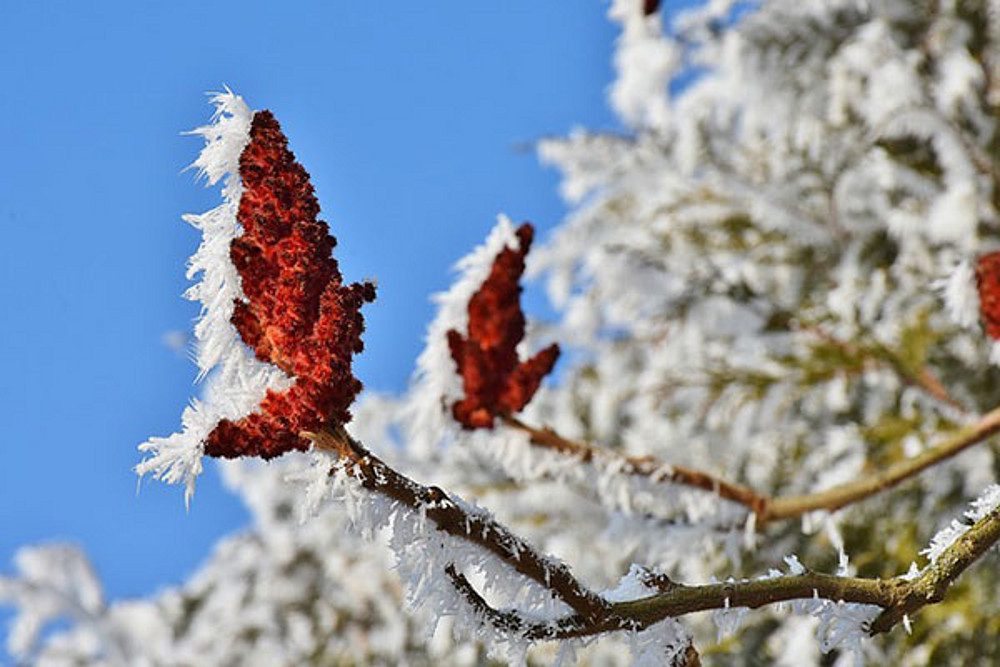
Knospen auf Baum mit Raureif. Foto pixabay

Kälteeinbrüche im Frühling können an Pflanzen schwere Frostschäden verursachen. Foto: pixabay

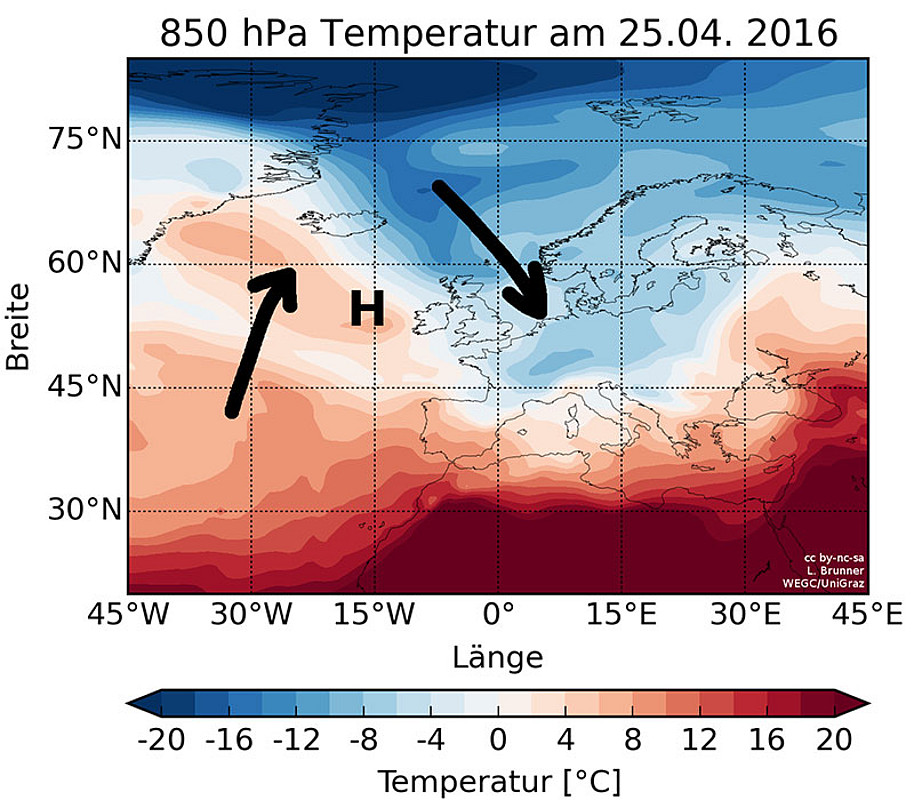
Ein stationäres Hoch westlich der Britischen Inseln sorgte im April 2016 für einen Kälteeinbruch in Zentraleuropa. Abbildung: Lukas Brunner, Wegener Center/Uni Graz; CC BY-NC-SA, https://creativecommons.org/licenses/by-nc-sa/3.0/at

Ein stationäres Hoch westlich der Britischen Inseln sorgte im April 2016 für einen Kälteeinbruch in Zentraleuropa. Abbildung: Lukas Brunner, Wegener Center/Uni Graz; CC BY-NC-SA, https://creativecommons.org/licenses/by-nc-sa/3.0/at

ForscherInnen der Uni Graz weisen häufigen Zusammenhang zwischen Kältewellen und Blocking-Wetterlagen nach

Wochenlang Temperaturen unter Null – aufeinanderfolgende Hochdruckgebiete über dem Atlantik und Europa bescheren uns seit Mitte Dezember 2016 eine relativ stabile Wetterlage. Bleibt ein stark ausgeprägtes Hoch an einem Ort hängen, bezeichnet das die Meteorologie als „Blocking“. ForscherInnen am Wegener Center für Klima und Globalen Wandel der Karl-Franzens-Universität Graz haben nun als Erste die Entwicklung und Auswirkungen von Blocking in Europa speziell im Frühling untersucht und dabei unter anderem folgenden signifikanten Zusammenhang entdeckt: Sehr häufig ist im Winter und beginnenden Frühling Blocking über dem Nordatlantik für Kälteeinbrüche in Zentral- und Südeuropa verantwortlich, wie etwa im April 2016, als der späte Frost große Schäden in der Landwirtschaft anrichtete. Um das stationäre Hochdruckgebiet entsteht eine Drehbewegung im Uhrzeigersinn, die nach und nach polare Luft nach Süden transportiert. Die aktuelle Studie wurde kürzlich in der Printausgabe des renommierten Journal of Climate veröffentlicht.

Angesichts des Klimawandels erhalten die Forschungsergebnisse besondere Relevanz. „Zwar hat die Häufigkeit von Blocking-Wetterlagen in den letzten Jahrzehnten nicht zugenommen, im Kontext der langfristigen Erwärmung treibt die Vegetation jedoch früher im Jahr aus, was das Problem von Frostschäden in Zukunft verschärfen könnte“, erklärt Ass.-Prof. Dr. Andrea Steiner, stellvertretende Leiterin des Wegener Center sowie der Forschungsgruppe für Atmosphärenfernerkundung und Klimasystem und Co-Autorin der Publikation.

„Wir haben für unsere Untersuchung die Jahre von 1979 bis 2014 herangezogen und jeweils die Monate Februar bis Juni einzeln betrachtet“, berichtet Erstautor Lukas Brunner, MSc. „Die Ergebnisse machen deutlich, dass Blocking im Winter und beginnenden Frühling vor allem mit Kältewellen verbunden ist, während es im späten Frühling und Anfang Sommer überwiegend Wärmeperioden mit sich bringt, weil das Hoch für Schönwetter sorgt und die Sonneneinstrahlung bereits stark genug ist“, fasst der junge Klimaphysiker zusammen.

Von wesentlicher Bedeutung sei außerdem, wo das Hochdruckgebiet gefangen ist. „Blocking westlich der Britischen Inseln führt vor allem dazu, dass polare Luft nach Südeuropa strömt. Hängt das Hoch über Skandinavien, kann es zwar ebenfalls weiter südlich kalt werden, wesentlich stärker ist jedoch der Effekt steigender Temperaturen vor Ort“, so Brunner, der in dem vom Österreichischen Wissenschaftsfonds FWF geförderten „Doktoratskolleg (DK) Klimawandel“ forscht.

Die Arbeit entstand in Kooperation mit Prof. Gabriele Hegerl von der University of Edinburgh, wo Lukas Brunner 2016 ein Semester lang forschte. Die Zuerkennung eines Marietta-Blau-Stipendiums vom Österreichischen Austauschdienst ermöglicht es ihm, ab kommendem Frühjahr ein halbes Jahr lang in Oslo weiter am Thema zu arbeiten.

Publikation
Connecting Atmospheric Blocking to European Temperature Extremes in Spring
Lukas Brunner, Gabriele C. Hegerl, Andrea K. Steiner
Journal of Climate, DOI: 10.1175/JCLI-D-16-0518.1

created by Gudrun Pichler

Related news

Jurassic Sounds: Biologist reconstructs insect songs from 165 million years ago

It was apparently not just the roars of the dinosaurs that made up the soundscape of the animal world during the Jurassic period. Crickets and grasshoppers communicated through a variety of songs and high-pitched sounds, as Thorin Jonsson from the Institute of Biology at the University of Graz discovered together with colleagues from the universities of Lincoln, Bristol (UK), Beijing (China) and Tempe (USA). The findings on what are so far the oldest traces of sound on Earth have just been published in the journal PNAS.

EU funding boosts international exchange between universities

The University of Graz is further expanding its international study opportunities through the European university alliance Arqus and is taking the lead in two key projects. In future, students will benefit from even more joint degree programmes and from simplified recognition of academic achievements through the Joint European Degree Label.

Rescue and risks: Researchers have surveyed public perceptions of AI

The use of artificial intelligence has had to be made transparent since 2 August 2026. The EU’s AI Act, which has been in force since then, also sets out how risky an application is and which security measures apply as a result. However, the assessment of risks by the legislation differs in some cases significantly from the perceptions of the Austrian public. This is the finding of a representative study carried out by data scientist Stefan Thalmann from the University of Graz and his team.

The Healing Sea: Researchers discover new approaches to treating chronic inflammation in sponges

Chronic inflammation plays a key role in many diseases, ranging from metabolic disorders and cardiovascular diseases to tissue damage following injuries or infections. “Normally, the body is able to resolve inflammation on its own. If this process becomes unbalanced, immune cells remain permanently active and continue to drive negative changes in the tissue,” explains Andreas Koeberle, a pharmacist at the University of Graz.

Begin of page section:
Additional information:

University of Graz
Universitaetsplatz 3
8010 Graz
Austria
  • Contact
  • Web Editors
  • Moodle
  • UNIGRAZonline
  • Imprint
  • Data Protection Declaration
  • Accessibility Declaration
Weatherstation
Uni Graz

End of this page section. Go to overview of page sections

End of this page section. Go to overview of page sections

Begin of page section:

End of this page section. Go to overview of page sections