Begin of page section:
Page sections:

  • Go to contents (Accesskey 1)
  • Go to position marker (Accesskey 2)
  • Go to main navigation (Accesskey 3)
  • Go to sub navigation (Accesskey 4)
  • Go to additional information (Accesskey 5)
  • Go to page settings (user/language) (Accesskey 8)
  • Go to search (Accesskey 9)

End of this page section. Go to overview of page sections

Begin of page section:
Page settings:

English en
Deutsch de
Search
Login

End of this page section. Go to overview of page sections

Begin of page section:
Search:

Search for details about Uni Graz
Close

End of this page section. Go to overview of page sections


Search

Begin of page section:
Main navigation:

Page navigation:

  • University

    University
    • About the University
    • Organisation
    • Faculties
    • Library
    • Working at University of Graz
    • Campus
    Developing solutions for the world of tomorrow - that is our mission. Our students and our researchers take on the great challenges of society and carry the knowledge out.
  • Research Profile

    Research Profile
    • Our Expertise
    • Research Questions
    • Research Portal
    • Promoting Research
    • Research Transfer
    • Ethics in Research
    • Commission for Scientific Integrity
    Scientific excellence and the courage to break new ground. Research at the University of Graz creates the foundations for making the future worth living.
  • Studies

    Studies
    • Prospective Students
    • Students
    • Registration for Study Programme (Winter semester 2026/27)
    • Study Days 22-26 June 2026
  • Community

    Community
    • International
    • Location
    • Research and Business
    • Alumni
    The University of Graz is a hub for international research and brings together scientists and business experts. Moreover, it fosters the exchange and cooperation in study and teaching.
Topics
  • Sustainable University
  • Researchers answer
  • Work for us
Close menu

End of this page section. Go to overview of page sections

Begin of page section:
You are here:

University of Graz News Getting even hotter: Researchers predict global warming of 1.7 degrees by 2027

End of this page section. Go to overview of page sections

Thursday, 25 June 2026

Getting even hotter: Researchers predict global warming of 1.7 degrees by 2027

excited boy having fun between water jets, in fountain. Summer in the city

The heat is becoming an increasingly serious problem: climate researchers at the University of Graz are forecasting a rise in the global average temperature of more than 1.7 °C by 2027. Photo: Olesia Bilkei/Adobe Stock

While Europe is currently sweltering in the heat, global temperatures are also rising towards concerning record levels. In 2026, Earth’s surface air temperature is expected to reach 1.62 degrees, and in 2027 even 1.71 degrees Celsius above pre-industrial levels. The long-term temperature rise – an average over a 20-year period – is predicted to exceed the 1.5-degree threshold of the Paris Agreement as of 2026 already. For the first time, researchers at the University of Graz have been able to make such a forecast so far in advance. The intensifying El Niño climate event favors forecast skill and thereby facilitates a reliable computation.

“Such an early and accurate forecast covering two years, combined with a long-term one extending to 2035, is a real first. We now understand the warming driven by human-made greenhouse gas emissions, in conjunction with climate fluctuations like El Niño, so well that we could make a reliable forecast,” explains Gottfried Kirchengast, climate researcher at the Wegener Center and Department of Physics at the University of Graz. His doctoral student Moritz Pichler, who developed the innovative methodology alongside him, adds: “We used observational data up to May 2026, seasonal forecasts from June onwards, and for the year 2027 our solid pre-knowledge on the continuing rise in global warming as well as the temperature dynamics during strong El Niño events.” 
However, the latter phenomenon contributes only a small part to the rising heat. The researchers find the long-term rise in temperature, fueled by the greenhouse gas emissions, particularly worrying. Their new reference dataset on global surface air temperature since 1850 shows, with over 99 percent statistical certainty, an accelerated increase since 1980 and, by now, a drastic collision with the Paris climate targets. Long-term warming will reach 1.55 degrees next year and is expected to exceed the Paris Agreement’s limit goal of “well below 2 degrees” as early as 2032, reaching over 1.7 degrees. “This is due to a lack of ambition in climate action. Climate hazards that could have been avoided, such as the current extreme heatwave in Europe, are a direct consequence,” says Kirchengast.

Latest analysis
In a recent publication, the physicist also presented a groundbreaking method for calculating risk levels for extreme weather and climate events (see News). In it, he demonstrates the link between the increase in thermal energy in the global atmosphere and the extreme heat in Austria and across Europe. Together with Jürgen Fuchsberger from his team, he has now applied the method to analyse the current heatwave in Austria and shows that even this single event is driven by global warming. His critical conclusion: “Given my prior knowledge, I am not technically surprised, but I am truly dismayed at how clearly a single heatwave alone reveals the impact of global warming and, with it, the failure of climate protection efforts to date. This is a glaring injustice towards poorer people who emit few greenhouse gases yet are severely affected, and towards the current generation of children.”

Reference dataset and heat hazard metrics:
The new reference dataset for this forecast and the hazard metrics for heat extremes and human heat stress in Austria and Europe are available via the Graz Climate Change Indicators – ClimateTracer web portal. 

Publications:
G. Kirchengast & M. Pichler: A traceable global warming record and clarity for the 1.5 °C and well-below-2 °C goals, 2025. 
G. Kirchengast, S. J. Haas & J. Fuchsberger: A new class of climate hazard metrics and its demonstration: revealing a ten-fold increase in extreme heat across Europe, 2026. 
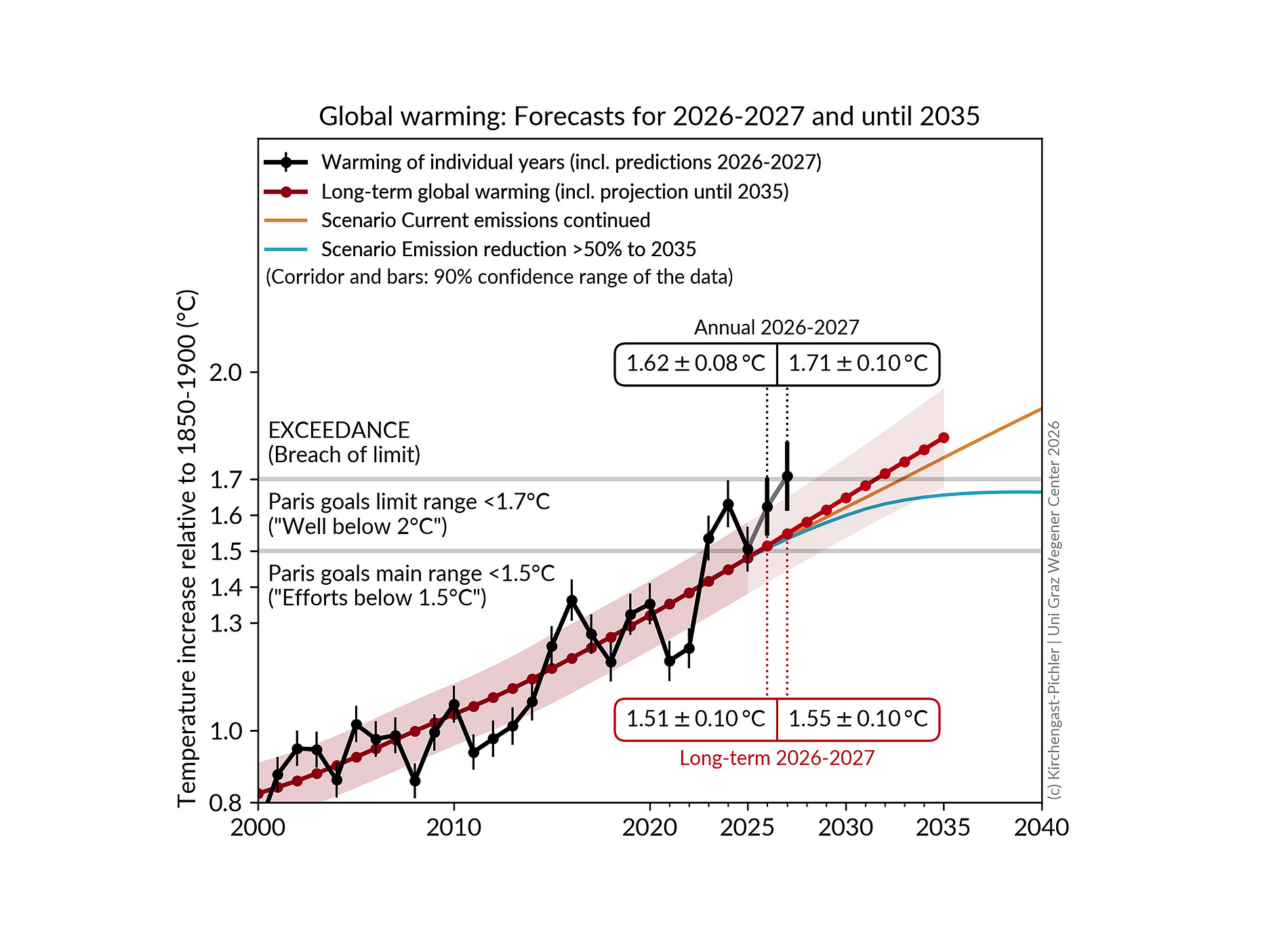
graphics describing the development of the global warming
The graphic illustrates the observed increase in global surface air temperature up to 2025, the prediction for 2026-2027 and the projected increase up to 2035. The observational data for the individual years extend to 2025, while the annual values for the long-term global warming extend to 2035 (each representing the average over 20 years, assigned to the central year; from 2016 onwards also including projection information). The forecast results for 2026 and 2027 are highlighted with numerical values (that include a 90 percent confidence range), for both the annual prediction and the long-term mean results.
The future up to 2040 is supplemented by two possible scenarios. The blue line depicts the IPCC's ambitious climate action scenario that is compliant with the Paris goals: strong emission reductions of over 50 percent by 2035 towards then achieving net-zero CO₂ emissions around the middle of the century. The orange line shows the scenario with current emissions continuing nearly unabated, leading to a failure to meet the Paris goals, with an exceedance of 1.7 °C already before 2035. The Paris target ranges for the <1.5°C main goal and the <1.7°C limit goal (for a sufficiently limited temporary overshoot of 1.5 °C in order to enable return to below this level again after 2050) are plotted as defined in the underlying publication by Kirchengast & Pichler (2025).
created by Dagmar Eklaude

Related news

Forest fire at Rosenhain: Volunteer fire brigade carried out an evacuation drill at the Jesuit refectory

Thick smoke in the stairwell, flames at the edge of the forest, people missing in the Jesuit refectory at the University of Graz: at Rosenhain, the Graz Volunteer Fire Brigade carried out a drill simulating a scenario that is becoming increasingly realistic given the heat and drought

Full effort in the heat: the Sports Centre was in full swing at the Kleeblattlauf

On 19 June 2026, 2,000 runners and hundreds of supporters made their way to the Rosenhain for a sporting end-of-term event.

New groundbreaking computation method for climate extremes

How much will heat, flooding, drought and storms increase as a result of human-induced climate change? In a groundbreaking study, climate researcher Gottfried Kirchengast and his team at the University of Graz have developed a new method for computing the hazards from extreme events: it can compute all relevant hazard metrics for events such as heat waves, floods and droughts in any region worldwide with unprecedented information content. Using it for Europe, the researchers found that anthropogenic climate change has caused a tenfold increase in extreme heat in recent decades. The study, published in the journal Weather and Climate Extremes, also provides a basis for better quantifying the damage to people, ecosystems and infrastructure.

Climate change unabated: Researchers predict global warming of almost 1.5 degrees for 2025

Summer is over. Despite a partly quite cool July, the last three months were very warm overall in Austria, with over 30 hot days, not to mention the extremely high temperatures in other parts of Europe and the world. Researchers at the University of Graz can now, for the first time, provide a reliable forecast of global warming for the entire year before autumn: in 2025, it is expected to reach 1.48 degrees Celsius above pre-industrial levels. The long-term temperature increase – the average over a period of 20 years – is also already very close to the 1.5-degree limit of the Paris Climate Agreement.

Begin of page section:
Additional information:

University of Graz
Universitaetsplatz 3
8010 Graz
Austria
  • Contact
  • Web Editors
  • Moodle
  • UNIGRAZonline
  • Imprint
  • Data Protection Declaration
  • Accessibility Declaration
Weatherstation
Uni Graz

End of this page section. Go to overview of page sections

End of this page section. Go to overview of page sections

Begin of page section:

End of this page section. Go to overview of page sections