





Begin of page section:
Page sections:

  • Go to contents (Accesskey 1)
  • Go to position marker (Accesskey 2)
  • Go to main navigation (Accesskey 3)
  • Go to sub navigation (Accesskey 4)
  • Go to additional information (Accesskey 5)
  • Go to page settings (user/language) (Accesskey 8)
  • Go to search (Accesskey 9)

End of this page section. Go to overview of page sections

Begin of page section:
Page settings:

English en
Deutsch de
Search
Login

End of this page section. Go to overview of page sections

Begin of page section:
Search:

Search for details about Uni Graz
Close

End of this page section. Go to overview of page sections


Search

Begin of page section:
Main navigation:

Page navigation:

  • University

    University
    • About the University
    • Organisation
    • Faculties
    • Library
    • Working at University of Graz
    • Campus
    Developing solutions for the world of tomorrow - that is our mission. Our students and our researchers take on the great challenges of society and carry the knowledge out.
  • Research Profile

    Research Profile
    • Our Expertise
    • Research Questions
    • Research Portal
    • Promoting Research
    • Research Transfer
    • Ethics in Research
    • Commission for Scientific Integrity
    Scientific excellence and the courage to break new ground. Research at the University of Graz creates the foundations for making the future worth living.
  • Studies

    Studies
    • Prospective Students
    • Students
    • Registration for Study Programme (Winter semester 2026/27)
  • Community

    Community
    • International
    • Location
    • Research and Business
    • Alumni
    The University of Graz is a hub for international research and brings together scientists and business experts. Moreover, it fosters the exchange and cooperation in study and teaching.
Topics
  • Sustainable University
  • Researchers answer
  • Work for us
Close menu

End of this page section. Go to overview of page sections

Begin of page section:
You are here:

University of Graz News Dr. Internet

End of this page section. Go to overview of page sections

Tuesday, 01 December 2015

Dr. Internet

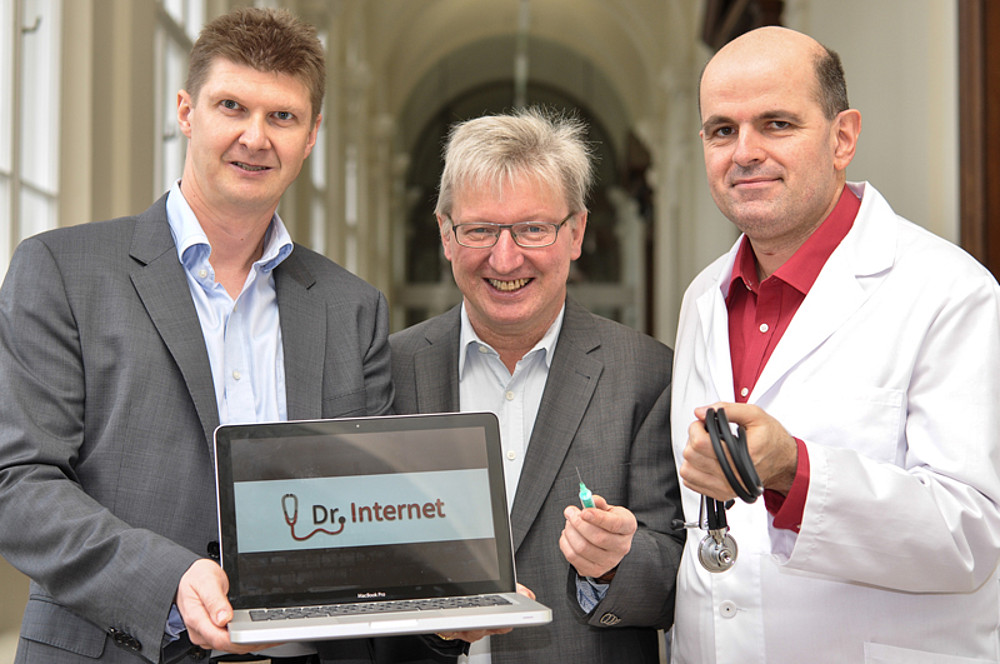
Michael Kopp von der Akademie für Neue Medien, Soziologe Franz Höllinger und Allgemeinmediziner Kurt Usar betreuen den MOOC "Krankheiten bestimmen mit dem Internet" (v.l.). Foto: Uni Graz/Tzivanopoulos

Michael Kopp von der Akademie für Neue Medien, Soziologe Franz Höllinger und Allgemeinmediziner Kurt Usar betreuen den MOOC "Krankheiten bestimmen mit dem Internet" (v.l.). Foto: Uni Graz/Tzivanopoulos

Die Webradio-Beiträge werden mit dem Web-Service Auphonic nachbearbeitet: http://auphonic.com

Die Webradio-Beiträge werden mit dem Web-Service Auphonic nachbearbeitet: http://auphonic.com

Auf Radio Soundportal sind die Webradio-Beiträge täglich einmal vormittags und einmal nachmittags zu hören: http://www.soundportal.at

Auf Radio Soundportal sind die Webradio-Beiträge täglich einmal vormittags und einmal nachmittags zu hören: http://www.soundportal.at

Das Webradio berichtet diese Woche über einen iMooX-Kurs zur Selbstdiagnose mit Hilfe des Internet

Das Webradio der Grazer Universitäten versorgt Studierende, MitarbeiterInnen, Lehrende, Forschende, Alumni sowie alle Interessierten wöchentlich mit vier Informationsbeiträgen. Ab dieser Woche geht startet das Programm wieder - mit folgenden Beiträgen:


1) Forschung: "Dr. Internet". Kann eine Internetrecherche den Gang zum/zu Hausärztin ersparen oder bringt man sich mit einer möglichen Falschdiagnose eher in Gefahr? Die Online-Plattform iMooX bietet ihren TeilnehmerInnen die Möglichkeit, die eigenen Recherchekenntnisse mit einem Kurs zu überprüfen und sie mit Ergebnissen von ÄrztInnen abzugleichen.


2) Bildung: "Der Nächste, bitte!" Die Ausbildung zum/zur Hausarzt/Hausärztin wird sich in Zukunft wesentlich weiter entwickeln: Nach der Basisausbildung ist nun beispielsweise erstmalig eine verpflichtende Zeit in einer Lehrpraxis vorgesehen. Auch der Berufsalltag der künftigen HausärztInnen wird anders ausschauen als in der Vergangenheit. Wie man außerdem einem Mangel an ÄrztInnen entgegenwirken könnte, weiß eine Expertin der Med Uni Graz.
 

3) Campusleben: "Die neuen Gesichter der TU Graz". Die TU Graz braucht laufend aktuelles Bildmaterial von Studierenden, ganz besonders wenn im kommenden Jahr die neue Website online geht. Daher startete die Universität im September ein Castingaufruf mit dem Titel „Be the Face“. Wer nach dem regen Interesse die sieben neuen Gesichter der TU Graz sind, verraten wir hier.


4) Aktuell gefragt: "Portiere im Portrait". Sie haben tagtäglich mit hunderten Studierenden zu tun, kümmern sich um Anliegen jeglicher Art und halten die KUG-Gebäude instand: die Portiere und Portierinnen an der Kunstuni Graz. Wir haben mit Monika Ruß und Mario Dobrounig über ihren Arbeitsalltag und ihre Erlebnisse an der KUG gesprochen.


Auch die erfolgreichen Kooperation mit Radio Soundportal - täglich sind dort die Webradio-Beiträge zu hören - besteht im neuen Semester weiterhin. 


created by Gerhild Kastrun

Related news

"Mathematics explains the world"

How can life be quantified? And what can science reveal that remains hidden from the naked eye? The 14th European Conference on Mathematical and Theoretical Biology at the University of Graz is dedicated to these questions. From 13 to 17 July, around 1,300 researchers from all over the world will gather on campus to discuss models, biological processes and the future of data-driven medicine. Klemens Fellner, Dean of the Faculty of Natural Sciences and Mathematics and a mathematician, talks about the language that explains the world

Internationally up-to-date: University of Graz offers new degree programmes in art studies

From the Old Masters to AI art – three newly designed degree programmes offer students at the University of Graz fresh perspectives on artistic production. In addition to historical art, the programmes place a greater emphasis on contemporary and global developments. The registration period is open.

The Nazi elite school Napola: Historian seeks memories and personal documents

They were to be brought up to become the future elite of National Socialism: boys and girls aged ten and over who, following the ‘Anschluss’ of Austria to the German Reich, attended a so-called Napola (short for Nationalpolitische Lehranstalt; also known as NPEA, Nationalpolitische Erziehungsanstalt). There were nine such institutions in what is now Austria between 1939 and 1945.

Heat-resistant: Eva Preinfalk explains how cities can protect their residents

Certain demographic and some occupational groups are particularly vulnerable to high temperatures. A range of measures is needed to provide relief for everyone, explains climate economist Eva Preinfalk.

Begin of page section:
Additional information:

University of Graz
Universitaetsplatz 3
8010 Graz
Austria
  • Contact
  • Web Editors
  • Moodle
  • UNIGRAZonline
  • Imprint
  • Data Protection Declaration
  • Accessibility Declaration
Weatherstation
Uni Graz

End of this page section. Go to overview of page sections

End of this page section. Go to overview of page sections

Begin of page section:

End of this page section. Go to overview of page sections