Begin of page section:
Page sections:

  • Go to contents (Accesskey 1)
  • Go to position marker (Accesskey 2)
  • Go to main navigation (Accesskey 3)
  • Go to sub navigation (Accesskey 4)
  • Go to additional information (Accesskey 5)
  • Go to page settings (user/language) (Accesskey 8)
  • Go to search (Accesskey 9)

End of this page section. Go to overview of page sections

Begin of page section:
Page settings:

English en
Deutsch de
Search
Login

End of this page section. Go to overview of page sections

Begin of page section:
Search:

Search for details about Uni Graz
Close

End of this page section. Go to overview of page sections


Search

Begin of page section:
Main navigation:

Page navigation:

  • University

    University
    • About the University
    • Organisation
    • Faculties
    • Library
    • Working at University of Graz
    • Campus
    Developing solutions for the world of tomorrow - that is our mission. Our students and our researchers take on the great challenges of society and carry the knowledge out.
  • Research Profile

    Research Profile
    • Our Expertise
    • Research Questions
    • Research Portal
    • Promoting Research
    • Research Transfer
    • Ethics in Research
    • Commission for Scientific Integrity
    Scientific excellence and the courage to break new ground. Research at the University of Graz creates the foundations for making the future worth living.
  • Studies

    Studies
    • Prospective Students
    • Students
    • Registration for Study Programme (Winter semester 2026/27)
  • Community

    Community
    • International
    • Location
    • Research and Business
    • Alumni
    The University of Graz is a hub for international research and brings together scientists and business experts. Moreover, it fosters the exchange and cooperation in study and teaching.
Topics
  • Sustainable University
  • Researchers answer
  • Work for us
Close menu

End of this page section. Go to overview of page sections

Begin of page section:
You are here:

University of Graz News Anerkennung

End of this page section. Go to overview of page sections

Friday, 13 May 2016

Anerkennung

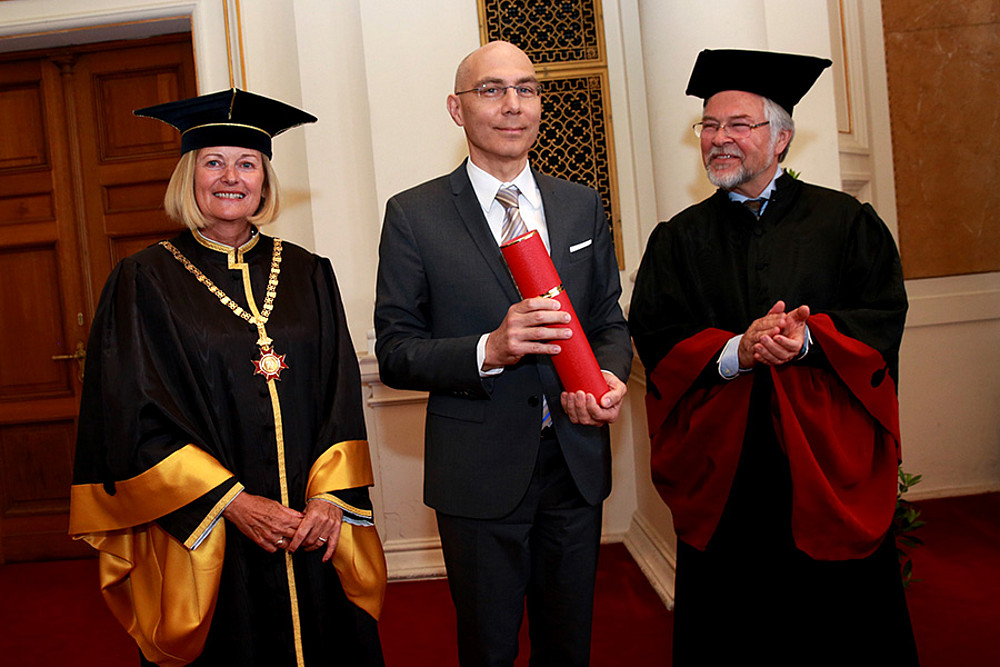
Menschenrechtspreis der Uni Graz für den Stellvertretenden UN-Flüchtlingshochkommissar Volker Türk (Mitte): Festakt in der Aula mit Rektorin Christa Neuper und Völkerrechtsexperten Wolfgang Benedek Foto: Gasser

Menschenrechtspreis der Uni Graz für den Stellvertretenden UN-Flüchtlingshochkommissar Volker Türk (Mitte): Festakt in der Aula mit Rektorin Christa Neuper und Völkerrechtsexperten Wolfgang Benedek. Foto: Gasser

Menschenrechtspreis der Uni Graz an Stellvertretenden UN-Flüchtlingshochkommissar Volker Türk verliehen

Der Menschenrechtspreis gehört zu den bedeutendsten Auszeichnungen, die von der Karl-Franzens-Universität Graz vergeben werden. Erst sechs Mal wurde er seit 1992 für herausragende Verdienste um Freiheit, Gerechtigkeit und Frieden verliehen, darunter an bekannte Persönlichkeiten wie den Dalai Lama, Simon Wiesenthal und Daniel Barenboim. Heute, am 13. Mai 2016, erhielt Dr. Volker Türk, Stellvertretender UN-Flüchtlingshochkommissar für Schutzfragen, den Menschenrechtspreis. Die Universität Graz würdigt damit über den Preisträger hinaus die Bemühungen des UN-Flüchtlingshochkommissariats UNHCR sowie die Arbeit aller, die sich für Flüchtlinge einsetzen.

Der Menschenrechtspreis für Volker Türk erfolgte auf Vorschlag von Univ.-Prof. Dr. Wolfgang Benedek, Leiter des Trainings- und Forschungszentrums für Menschenrechte und Demokratie, und wurde einstimmig vom Senat der Karl-Franzens-Universität beschlossen. Benedek: „Mit dem Preis soll einerseits die herausragende Persönlichkeit von Volker Türk geehrt werden, der sich seit 25 Jahren weltweit dem Schutz der Flüchtlinge gewidmet hat und andererseits die zentrale Rolle des Flüchtlingshochkommissariats der Vereinten Nationen für die Unterstützung der Flüchtlinge hervorgehoben werden.“

Rektorin Univ.-Prof. Dr. Christa Neuper überreichte die Urkunde an Volker Türk im Rahmen eines Festaktes in der Aula und hob die gesellschaftliche Rolle der Universität hervor: „Die Verleihung des Preises ist ein Signal dafür, sich in der Flüchtlingsthematik zu engagieren. Bereits im vergangenen September haben WissenschafterInnen und Studierende rasch ein Maßnahmen-Paket geschnürt, um anerkannten Flüchtlingen und AsylwerberInnen den Zugang zu Bildung zu erleichtern.“

Der Preisträger widmete die Auszeichnung in seiner Dankesrede all jenen, die vor Verfolgung und Krieg flüchten und auf der Suche nach Schutz sind. „Mit mehr als 60 Millionen Vertriebenen weltweit ist es wichtiger denn je, dem Flüchtlingsschutz ein besonderes Augenmerk zu schenken. Ich danke dem Senat der Universität Graz für seine Auswahl daher von tiefstem Herzen. Der Flüchtlingsschutz ist eine ganz wichtige Säule der Menschenrechte und hat in den vergangenen Jahrzehnten Millionen Menschen nicht nur das Leben gerettet, sondern ihnen auch die Chance auf eine neue Zukunft gegeben. Ich möchte in diesem Zusammenhang auch der Universität Graz herzlich gratulieren für ihr Engagement für Flüchtlinge und im Bereich der Menschenrechte“, so Türk.

Zum Preisträger
Dr. Volker Türk ist gegenwärtig Stellvertretender UN-Flüchtlingshochkommissar für Schutzfragen. Vor seiner Ernennung als Stellvertretender UN-Flüchtlingshochkommissar war er Direktor für internationalen Rechtsschutz am Sitz des UN-Flüchtlingshochkommissariats (UNHCR) in Genf. Von April 2008 bis September 2009 hatte er die Funktion des Direktors der Abteilung für Organisationsentwicklung und Management inne, wo er maßgeblich die Strukturreform von UNHCR mitgestaltete. Zuvor bekleidete der gebürtige Oberösterreicher unterschiedliche Posten für UNHCR in verschiedenen Regionen der Welt, unter anderem in Malaysia, im Kosovo, in Bosnien-Herzegowina, der Demokratischen Republik Kongo und Kuwait. Von 2000 bis 2004 leitete er die Sektion für Schutzpolitik und Rechtsberatung in der Genfer Zentrale und war dabei vor allem für den Globalen Konsultationsprozess von UNHCR verantwortlich. Vor seiner Karriere bei UNHCR war Volker Türk Assistent am Institut für Völkerrecht der Universität Wien, wo er seine Doktorarbeit über das UN-Flüchtlingshochkommissariat UNHCR und dessen Mandat abschloss.
Türk ist Autor zahlreicher Publikationen im Bereich des internationalen Flüchtlingsrechts und der Menschenrechte.

created by Andreas Schweiger

Related news

Complying with the norm: Why Do Standards Shape Our Lives, Elisabeth Staudegger?

Standards determine whether a sheet of paper fits in a printer or whether a charging plug can power multiple devices. These standards shape our everyday lives. But who actually sets these standards? Where are the weaknesses, and how could science help to improve them? Elisabeth Staudegger, Head of the ‘Law and IT’ Department at the Institute for Legal Foundations at the University of Graz, host the Academic Standards Day on 16 June. Here she relays how sciences can contribute to the topic of standardisation and reveals her personal favourite standard.

More body awareness than a culture war

In Italy, sex education lessons will in future only be permitted with parental consent, and will be banned entirely in nurseries and primary schools. At the same time, Pride Month highlights why knowledge about the body, relationships, boundaries and diversity is important for young people. A study by the University of Graz shows how important knowledge about the body, contraception, relationship skills and protection against violence is

Will Austria win the World Cup? Mathematician reveals calculation method

Michael Fischer uses the football tournament as a practical example for highschool lessons.

Survival strategies: How plants respond to drought

According to Geosphere Austria, this spring was the driest in Austria since records began around 170 years ago. The low rainfall put particular pressure on the agricultural sector. And climate change is set to make the situation even worse in the coming decades. We asked Johannes Liesche, a professor at the Department of Biology at the University of Graz, how plants react to water shortages and how they survive periods of drought.

Begin of page section:
Additional information:

University of Graz
Universitaetsplatz 3
8010 Graz
Austria
  • Contact
  • Web Editors
  • Moodle
  • UNIGRAZonline
  • Imprint
  • Data Protection Declaration
  • Accessibility Declaration
Weatherstation
Uni Graz

End of this page section. Go to overview of page sections

End of this page section. Go to overview of page sections

Begin of page section:

End of this page section. Go to overview of page sections