Political Participation in Post-Protest Societies: Stories from Bosnia & Herzegovina, Brazil, Bulgaria and Turkey
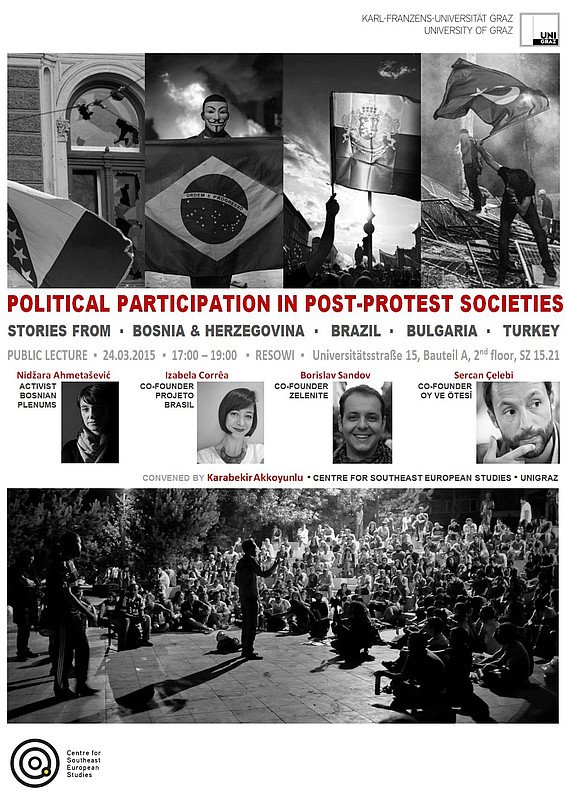
What are the challenges, limitations and opportunities in keeping citizens engaged in politics and activism after the end of a relatively brief but intense period of demonstration? How can the social energy tapped by protest movements be harnessed to affect long-term political and institutional change? Which groups are more likely to remain engaged and which are likely to drop out? How do governments’ reactions during protests and afterwards influence post-protest political participation?
We are joined by four highly engaged citizens from Bosnia & Herzegovina, Brazil, Bulgaria and Turkey with first hand experience in post-protest political participation who will share with us their stories and help us answer these questions:
Nidžara Ahmetašević is a journalist and independent scholar with a PhD from the University of Graz. Her fields of interest are democratisation and media development in post conflict society, transitional justice, process of facing with the past, media and political propaganda, human rights. As an activist, Nidžara was involved with the work of plenums in Bosnia & Herzegovina over the spring 2014, as well as several other initiatives in Bosnia and the region over the last 20 years.
Izabela Corrêa is a PhD Candidate in Political Science at the London School of Economics. Previously, she worked as a public policy practitioner in the Federal Government of Brazil, where she developed and coordinated the implementation of multiple policies in the area of anti-corruption and transparency. She is the co-founder of Projeto Brasil, an initiative to inform voters about candidates' policy proposals and monitor their implementation.
Borislav Sandov is the co-founder and former co-chair of Зелените, the Bulgarian Green Party. He is also a member of the Bulgarian branch of the Anna Politkovskaya free speech foundation, as well as the 'Climate Action Coalition', the most active network of green NGOs in Bulgaria. Over the past eight years, he has been involved in the coordination teams of numerous protest movements in Bulgaria, some of them anti-governmental (such as the Protest Network) and others sectoral (mainly environmental and energy topics: GMOs, fracking, nuclear energy, conservation, etc.).
Sercan Çelebi is the co-founder and president of Oy ve Ötesi (Vote and Beyond), a non-partisan volunteer organisation borne out of the Gezi protests that mobilises citizens to vote and monitor the electoral process in Turkey. A graduate of Yale University with a BA in Economics and International Studies, Sercan has worked in management consultancy and is a former owner of the agribusiness venture in industrial tomatoes and peppers production in Western Turkey.