Begin of page section:
Page sections:

  • Go to contents (Accesskey 1)
  • Go to position marker (Accesskey 2)
  • Go to main navigation (Accesskey 3)
  • Go to sub navigation (Accesskey 4)
  • Go to additional information (Accesskey 5)
  • Go to page settings (user/language) (Accesskey 8)
  • Go to search (Accesskey 9)

End of this page section. Go to overview of page sections

Begin of page section:
Page settings:

English en
Deutsch de
Search
Login

End of this page section. Go to overview of page sections

Begin of page section:
Search:

Search for details about Uni Graz
Close

End of this page section. Go to overview of page sections


Search

Begin of page section:
Main navigation:

Page navigation:

  • University

    University
    • About the University
    • Organisation
    • Faculties
    • Library
    • Working at University of Graz
    • Campus
    Developing solutions for the world of tomorrow - that is our mission. Our students and our researchers take on the great challenges of society and carry the knowledge out.
  • Research Profile

    Research Profile
    • Our Expertise
    • Research Questions
    • Research Portal
    • Promoting Research
    • Research Transfer
    • Ethics in Research
    Scientific excellence and the courage to break new ground. Research at the University of Graz creates the foundations for making the future worth living.
  • Studies

    Studies
    • Prospective Students
    • Students
  • Community

    Community
    • International
    • Location
    • Research and Business
    • Alumni
    The University of Graz is a hub for international research and brings together scientists and business experts. Moreover, it fosters the exchange and cooperation in study and teaching.
  • Spotlight
Topics
  • Our digital Advent calendar
  • Sustainable University
  • Researchers answer
  • Work for us
Close menu

End of this page section. Go to overview of page sections

Begin of page section:
You are here:

University of Graz Spotlight How artificial intelligence is changing the digital future in Europe

End of this page section. Go to overview of page sections

How artificial intelligence is changing the digital future in Europe

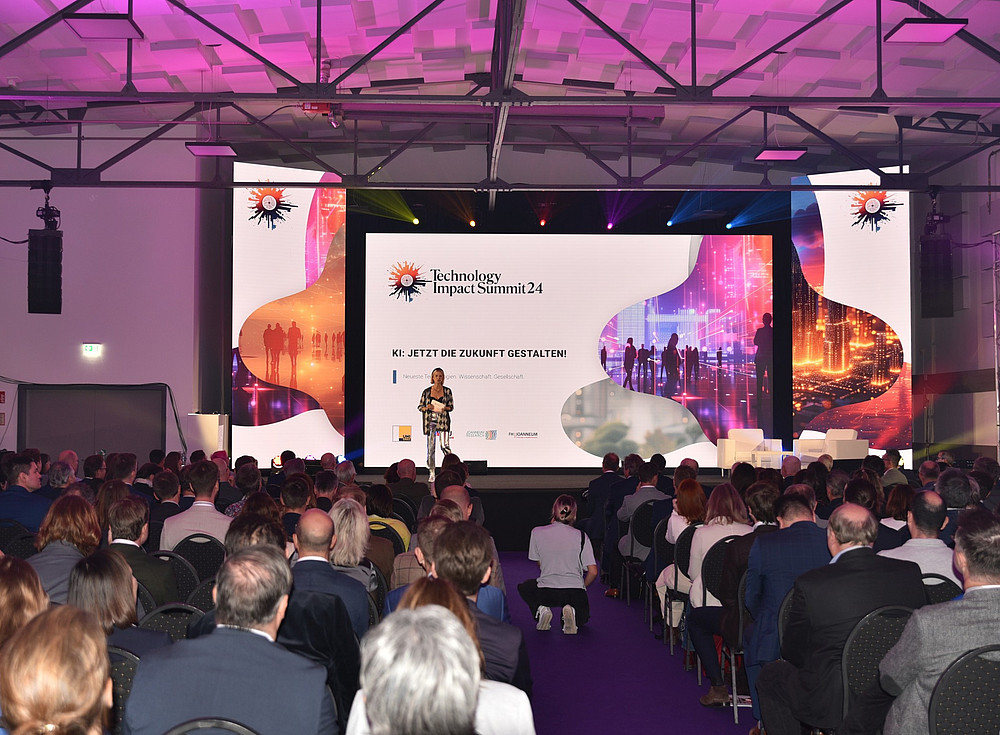
a large hall with audience, stage and big led screen displaying the logo of " technology impact summit" conference in white background. a woman is standing on the stage giving speech to crowd people sitting below her at a business event.

TIS celebrated its premiere in 2024. Photo: University of Graz/Vilgut

On November 20, 2025, the Technology Impact Summit at the Seifenfabrik in Graz will bring together experts from politics, business, and science. The focus will be on how artificial intelligence is transforming our working world and which specific AI solutions are already being used successfully today.

Artificial intelligence is becoming increasingly prevalent in many people's everyday working lives. Whether it's translations, creating project plans, or simple programming tasks. How far can this development go, and what impact will digital transformation have on our society and on Europe's digital future? These questions will be explored by participants at the Technology Impact Summit (TIS), which will take place for the second time in Graz on November 20, 2025.

“The Technology Impact Summit celebrated its successful premiere in 2024,” says Markus Fallenböck, Vice Rector of the University of Graz and co-initiator of the TIS. “We have now moved beyond the chatbot phase and are focusing on the successful integration of AI into the core tasks of organizations. To do this, we need to combine technological expertise with the relevant specialist knowledge, measure progress, and get our teams on board.” Experts from various fields will provide insight into how this can be achieved.

Practical examples

This is not about dry theory. Seven companies, ranging from start-ups to established players such as Deutsche Telekom and Austrian Post, will present concrete examples of how they are already using the tools today. There will also be exciting keynote speeches. Ramin Hasani, CEO of Liquid AI, explains how AI can not only work better, but completely differently – and why this affects us all. UNESCO expert Mariagrazia Squicciarini shows approaches that enable us not only to learn the relevant skills, but also to apply them correctly from the outset. Management consultant and former politician Karl-Theodor zu Guttenberg talks about the challenges associated with regulating AI in the EU.

On the eve of the summit, participants will experience a journey through time in the historic reading room of the university library. In a live performance, the Science Busters will bridge the gap between the Graz Mummy Book, a 2,000-year-old papyrus fragment with signs of a kind of book binding, and state-of-the-art AI.

The Technology Impact Summit is a joint initiative of the University of Graz, Graz University of Technology, JOANNEUM RESEARCH, and FH JOANNEUM. Together, they demonstrate how research and technology work together.

Want to know how artificial intelligence will change the working world of the future? Complete the micro-degree “Artificial Intelligence and Society” at the University of Graz.

created by Roman Vilgut

Related news

Chemical Christmas show at the University of Graz: An explosive evening at the Schauspielh

At the beginning of December, the University of Graz transformed the theater into a laboratory: as part of “Chemical Life,” teacher training students staged a chemical Christmas show for Styrian school classes—complete with ethanol rockets, nitrogen snow, and glowing effects. An evening designed to inspire interest in studying chemistry.

Train by train: Koralm railway accelerates exchange between the Universities

Lectures at the University of Klagenfurt in the morning, seminars at the University of Graz in the afternoon: Austria's longest tunnel and a journey time of around 45 minutes make it easy. The Koralm railway increases the speed of networking between the two university locations. The collaboration builds on existing cooperation - for example in the areas of teacher training, Slavic studies and as employers, the universities are well coordinated.

On the trail of the Big Bang: University of Graz receives 1.5 million euros for doctoral programmes

The Austrian Science Fund FWF has selected the Doctoral Programme in Theoretical Particle Physics at the University of Graz for funding from the Doc.funds. Six young scientists will be funded for 3.5 years. They will gain fundamentally new insights into the origins of the world.

From trans women and knee prostheses: sports science prizes awarded

Walking better with a prosthesis, successfully getting rid of excess weight, training more effectively, more fairness for trans people in sport: these were the topics addressed by the students at the University of Graz who were awarded the sports science prizes for their Master's theses on 3 December 2025.

Begin of page section:
Additional information:

University of Graz
Universitaetsplatz 3
8010 Graz
Austria
  • Contact
  • Web Editors
  • Moodle
  • UNIGRAZonline
  • Imprint
  • Data Protection Declaration
  • Accessibility Declaration
Weatherstation
Uni Graz

End of this page section. Go to overview of page sections

End of this page section. Go to overview of page sections

Begin of page section:

End of this page section. Go to overview of page sections